
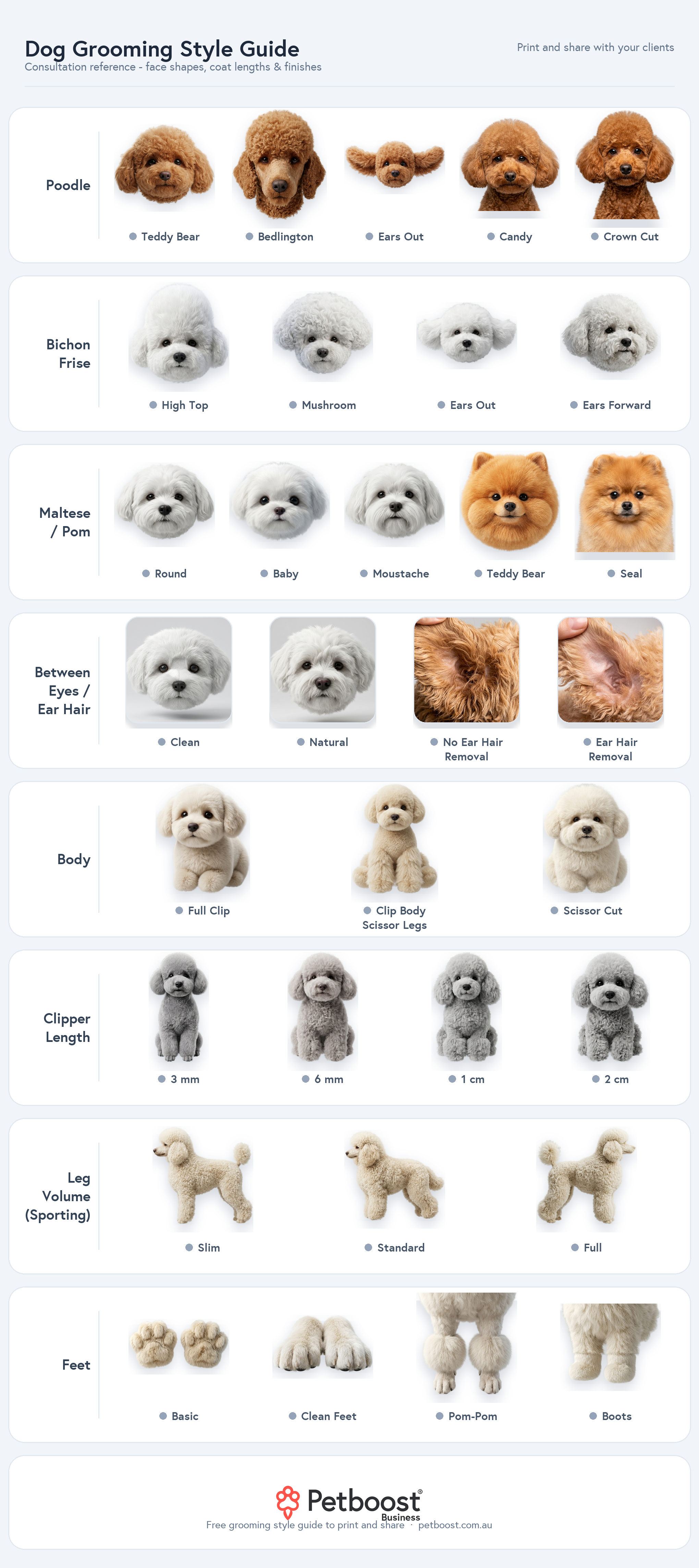
Ask ten dog owners for a "puppy cut" and you will groom ten different dogs. One pictures a fluffy teddy bear face, another wants the coat clipped right down for summer, and a third simply means "tidy and short". The words we use for grooming styles are slippery, and the gap between what a client pictures and what they actually say is where unhappy collections are born.
The short version
It's a printable consultation sheet, not a training manual. You walk the owner through it one row at a time: settle the face first, then body length, then the details. If you already photograph every finished groom and log the clipper length, you have this covered. If you're still decoding “a bit shorter”, print it.
The fix is not more talking. It is a picture. When a client can point at the exact face shape, coat length and finish they want, the brief becomes obvious and the dog that walks out matches the one in their head.
This is that picture. A complete dog grooming style guide you can print for the salon, text to a client before their booking, or work through together at drop off. It is free, it is made for sharing, and it covers every decision that changes how a groom turns out.
How to Use It in a Consultation
The guide works best as a shared reference, not a quiz. At drop off, or in a message the day before, walk the owner through it one row at a time and pick a single option from each.
- Start with the face. This is the part owners feel most strongly about, so settle it first.
- Then the body and the length. Decide how the coat is taken off (clipped, scissored or a mix) and how short it goes.
- Finish with the details. Ears, leg volume and feet are quick to agree once the big choices are made.
- Photograph the result. A before and after photo turns this groom into the reference for the next one.
Five small decisions, each from a picture, and the brief is locked. No more "a bit shorter than last time" left open to interpretation.
Face Shapes, Breed by Breed
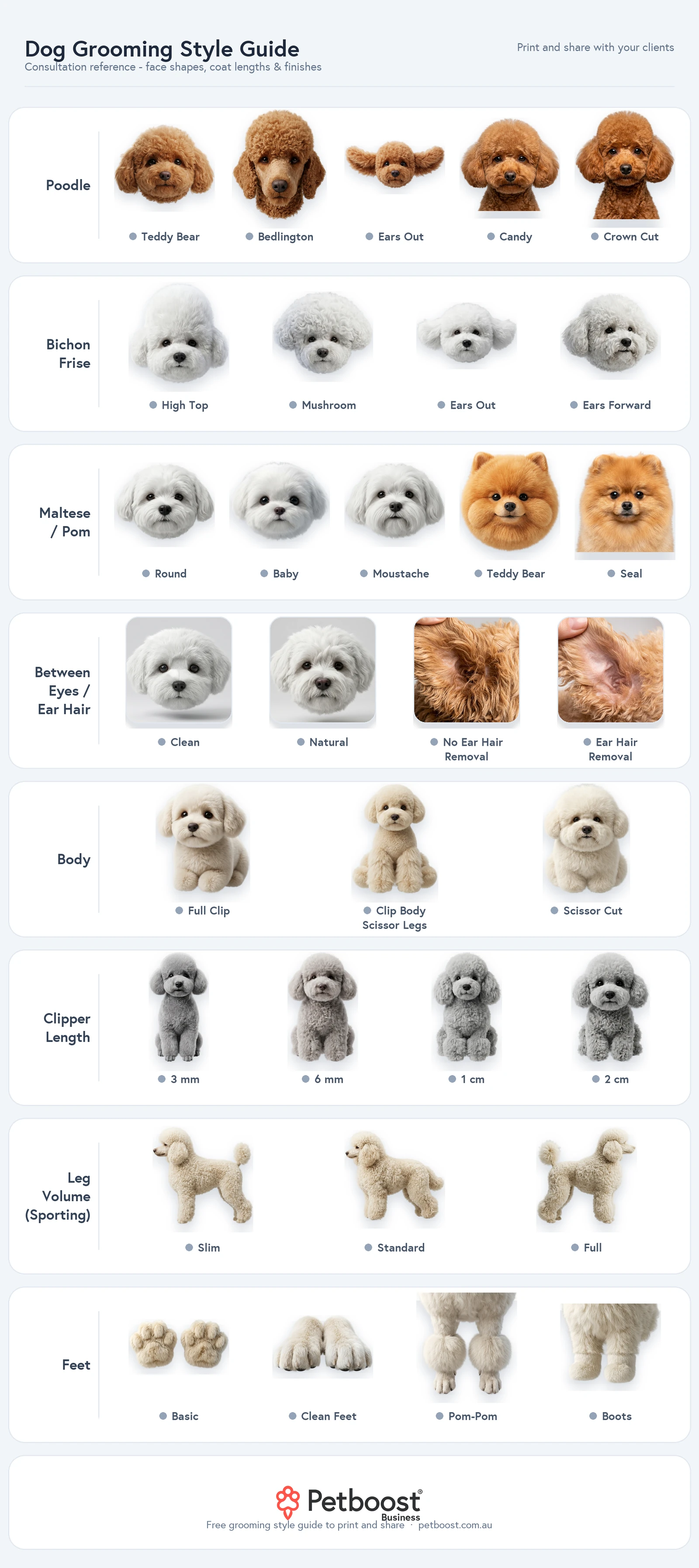
The face is where breed and styling meet, so the same words mean slightly different things on different coats. Here is what each option on the chart looks like.
Poodle
- Teddy Bear. The classic. A round, soft face with the muzzle left full so the whole head reads as one fluffy circle.
- Bedlington. Taller and more shaped, with a rounded dome on top and a narrower, lamb like face.
- Ears Out. The ear fringe is shaped to flare out to the sides rather than blending into the cheeks.
- Candy. A sweeter, heart shaped outline with two soft lobes on top.
- Crown Cut. The top of the head is trimmed flat and square, a neat, modern look that holds its shape as it grows.
Bichon Frise
- High Top. A tall, rounded pouf of coat lifting above the head.
- Mushroom. A wider, flatter cap that overhangs a small, round muzzle.
- Ears Out and Ears Forward. Two ways to set the ears, either flared to the sides or swept forward over the cheeks, which completely changes the expression.
Maltese and Pomeranian
- Round and Baby. Both are soft and circular, with Baby leaning shorter and cuter, big eyes and a tiny muzzle.
- Moustache. More coat is left around the muzzle and chin for a fuller, characterful face.
- Teddy Bear (Pomeranian). The fox like face rounded off into a plush, cuddly shape.
- Seal. The compact, rounded Pomeranian trim that makes the dog look a little like a baby seal.
Between the Eyes and Ear Hair
Two small choices that owners rarely think to mention, and that quietly make or break a face.
- Clean between the eyes means the bridge is tidied so the eyes stand out. Natural leaves the fringe soft and full.
- Ear hair can be left in place or removed. This is partly a styling choice and partly a hygiene one, so it is worth asking every time rather than assuming.
Body: How Much to Clip
This row decides how the coat comes off, which is different from how short it ends up.
- Full Clip. Clipped short and even all over for an easy care, low fuss finish.
- Clip Body, Scissor Legs. The body is clipped short while the legs are left full and scissored, a popular look that keeps maintenance down but holds some shape and fluff.
- Scissor Cut. Scissored all over to keep length and a rounded, plush outline. The most work, and the most teddy like result.
Clipper Lengths, Decoded
When an owner says "short", ask which short. The clipper length sets exactly how much coat is left, and it is the single biggest driver of how a dog looks and how often it needs brushing at home.
| Clipper length | The look | Often chosen for |
|---|---|---|
| 3 mm | Very short and neat, the shape of the dog shows through | Easy care, hot weather, or resetting a matted coat |
| 6 mm | Short with a little plush, still low maintenance | A tidy everyday length that grows out gracefully |
| 1 cm | Medium and soft to the touch | A balance of fluffy and practical |
| 2 cm | Full and fluffy, the most teddy like | Owners who love a plush coat and will brush at home |
A quick word on matting. If a coat is matted, the kind thing is often to go shorter than the owner first asks, because brushing out tight mats hurts. Showing the length on the chart and explaining why makes that conversation easier and kinder.
Leg Volume for Sporting Trims
On sporting and poodle trims, the legs carry a lot of the style. The guide shows three levels, Slim, Standard and Full, so an owner can choose how much leg volume they want rather than leaving it to chance. Slim is sleek and modern, Full is showy and plush, and Standard sits comfortably in between.
Feet: Four Small Choices That Finish the Look
Feet are the detail people notice without knowing why.
- Basic. Natural and softly rounded.
- Clean Feet. Trimmed tight and short for a neat, defined paw.
- Pom-Pom. A round puff of coat left around the ankle, like a little bracelet.
- Boots. Even coat left straight down the leg to the foot for a sturdy, cosy look.
Five Ways to Nail the Brief Every Time
- Lead with the picture, not the words. Let the owner point. It is faster and far more accurate than describing.
- Pick one option per row. Face, body, length, legs, feet. Five clear choices and you are done.
- Repeat it back. Say the full brief out loud so any mismatch surfaces before the clippers come out.
- Take a before and after photo. It protects you and gives next time a head start.
- Write it down where it will be found again. A brief that lives in someone's memory is a brief that gets lost.
Keep Every Dog's Style on File
A great brief is only useful if it survives to the next appointment. The quiet drain in a grooming business is re-explaining the same dog every visit, or a new team member guessing because the notes live in one person's head.
In Petboost, every pet has a profile where you can save their agreed style, clipper length, the bits they hate, coat and skin notes, and before and after photos. When the dog is booked again, the whole brief is right there on the appointment for whoever is on the tools that day. The picture the owner chose once quietly becomes the standard every single time.
Frequently Asked Questions
What is a teddy bear cut? A rounded, soft trim that leaves the face full and circular so the head reads as one fluffy shape. It is most associated with poodles and poodle crosses, but the same idea is used on bichons, maltese and pomeranians.
What clipper length should I ask for? If you want easy care and a neat finish, 3 mm to 6 mm is a safe range. If you love a plush, fluffy coat and are happy to brush at home, ask for 1 cm to 2 cm. When in doubt, ask your groomer what suits your dog's coat and lifestyle.
How is a full clip different from a scissor cut? A full clip uses clippers to take the coat short and even all over for low maintenance. A scissor cut keeps length and shape using scissors, which takes more skill and more brushing at home, but gives that rounded, teddy like look.
Can I print this and share it with my clients? Yes. It is made to be printed, pinned up and shared. Pop it on the salon wall, send it before a booking, or hand it over at drop off.
Print it, share it, agree on it
Download the A4 PDF for the wall, or download the high resolution image to send to clients. A shared picture is the simplest tool in grooming, and it is free.